
Home of the craft
Craft Heritage · Chapter One
White thread,
Lucknow hands.
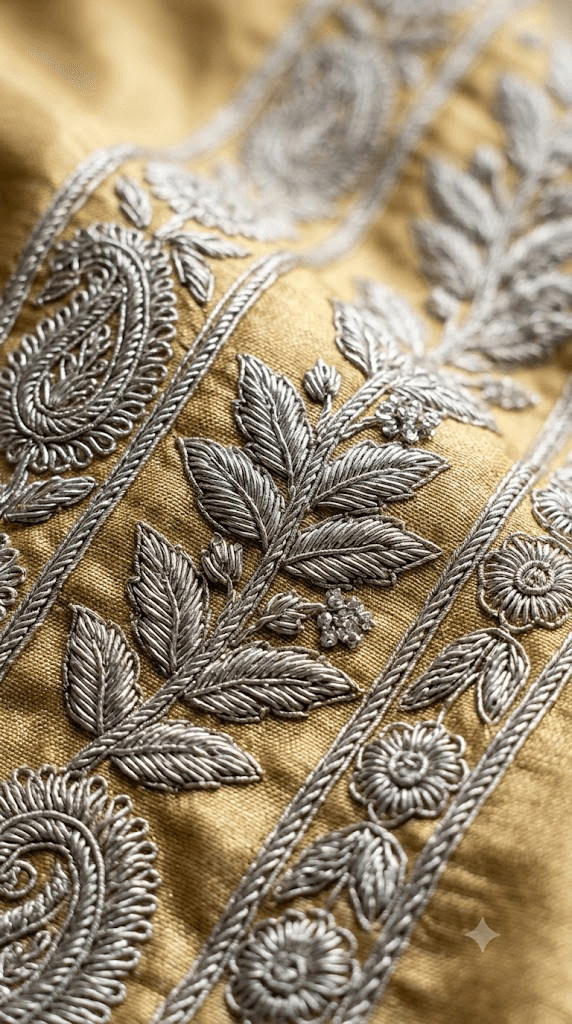
A white-on-white embroidery tradition of Awadh, worked by hand on fine cotton and muslin. Its story, its stitches, and how to recognise the real thing.
Recognised
Geographical Indication, 2008
Traditionally worked on
Muslin, mulmul & cotton
Made by
Hand embroiderers, predominantly women
01 — History
Four centuries of story, a few centuries of record.
Chikankari's origins are contested. What is well established begins in Awadh, where court patronage made Lucknow the craft's home.Before 1775
Origins, contested
Persian, Mughal and Bengal-muslin threads all appear in accounts of the craft. No single origin story is settled.
1775
Awadh’s capital moves to Lucknow
Nawabi patronage concentrates skilled artisans in Lucknow and helps establish the standards associated with the craft.
1851
London’s Great Exhibition
Chikan embroidery is shown to an international audience.
1856–57
Awadh falls
Court patronage ends and artisans lose their principal patrons, but the practice survives through households and local markets.
2008
Geographical Indication
Lucknow Chikankari receives GI status, formally recognising its regional identity.
02 — The Making
From printed cloth to finished garment.
Design & block printing
Motifs are stamped onto the cloth using a washable dye.
Hand embroidery
The printed lines are worked by hand, stitch by stitch, in white or matching thread.
Washing
The printed guide is washed away, leaving the embroidery visible.
Finishing
The cloth is checked, pressed, cut and finished into the garment.
03 — The Stitches
Many expressions, one patient thread.
Chikankari includes flat, raised and open-work techniques. These are the stitches you will meet most often.Flat
Tepchi
Long, simple running stitches worked on the surface of the cloth.Flat
Bakhia
Shadow work stitched on the reverse so the pattern shows softly on the front.Flat
Zanzeera
A fine chain stitch used to outline stems, leaves and petals.Eyelet
Hool
A tiny pierced eyelet, often placed at the centre of a flower.Raised
Murri
A small, grain-like knot stitch that creates texture.Raised
Phanda
A finer round knot, often described as millet-like.Open-work
Jaali
Threads are carefully drawn apart—not cut—to form a delicate mesh.Appliqué
Khatau
Layers of fabric are folded and stitched to create a raised motif.04 — The Hands
Made at home, predominantly by women.
Many embroiderers work from their homes in Lucknow and nearby communities such as Malihabad and Mohanlalganj. BeHAZEL'd seeks to source with care, understand who made each piece, and build relationships that respect both skill and origin.
05 — Authenticity
How to tell hand from machine.
Turn it over
Look at the reverse. Hand embroidery carries knots, travelling threads and the individual logic of the maker's hand.
Look for variation
Hand stitches vary subtly in length, tension and spacing. Machine work is far more uniform.
Ask who made it
Authentic provenance matters. Ask where a piece was made, how it was embroidered and who was involved.
An Evolving Archive
Chikankari is where our journey begins.
As BeHAZEL'd travels to other regions of India, this archive will grow—introducing the people, history, techniques and living traditions behind every craft in our Curated Closet.
Explore the Curated Closet